Tourmaline
Tourmalines
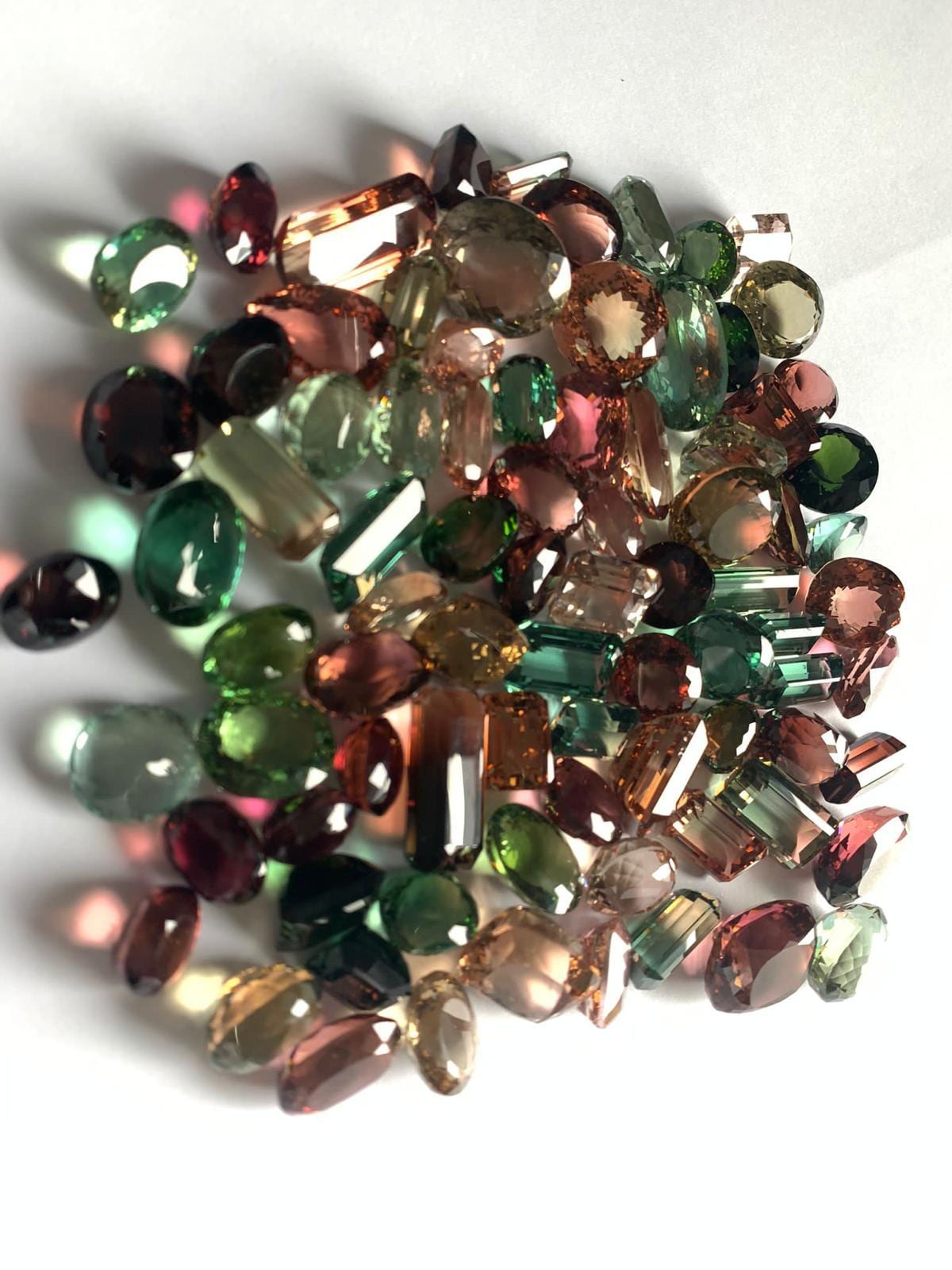
Varieties
How tourmalines are categorised
Trade categories rather than gemological ones — these are the terms a requirement is normally written in.
- Green Tourmaline
- Mint through forest; the most available colour across sizes.
- Pink Tourmaline
- Pastel through hot pink, widely used in bridal and fashion lines.
- Rubellite
- Strong red to purplish red — the top of the pink range and priced as such.
- Indicolite
- Blue to blue-green. Scarcer than the greens and pinks.
- Bi-colour Tourmaline
- Two distinct colours in one stone, cut to show the boundary.
- Parti-colour Tourmaline
- Three or more colour zones in a single stone.
- Watermelon Tourmaline
- Pink core with green rim; usually cut in slices to show the pattern.
- Chrome Tourmaline
- Vivid saturated green from chromium and vanadium; small sizes dominate.
- Paraíba-type Tourmaline
- Copper-bearing neon blue-green. Sold with a report identifying it as such.
Tourmalines in detail
Buying tourmaline by colour
Tourmaline is the species where sending a reference image is worth more than any written description. "Green tourmaline" covers mint, olive, grass, teal and near-black; "pink" covers everything from a barely-there pastel to rubellite. A photograph of the target colour narrows a sourcing request faster than a paragraph.
Because the colour range is continuous rather than banded, tourmaline suits palette-driven design work particularly well. Buyers assembling a collection often send a colour story rather than a stone list, and we work back from that.
Strong, evenly saturated colour in larger sizes is where availability tightens — especially in rubellite, indicolite and the vivid chrome greens. The pastels and the mid-tone greens remain broadly available.
Pleochroism affects how the stone is cut
Tourmaline shows markedly different colour along different crystal directions, and it is usually darker down the length of the crystal than across it. Cutters orient the stone to control this, which is why long rectangular and emerald-cut outlines are so common in the species — the shape follows the crystal.
The practical consequence for a buyer is that face-up colour and the colour you see looking through the side of the stone can differ noticeably. Assess tourmaline face-up, in the orientation it will be set.
Deeply saturated material is often cut shallow on purpose to keep the stone from going too dark. If you are setting into a shallow bezel this works in your favour; if you need depth for a specific mount, state it.
Bi-colour, parti-colour and cutting to the zone
Bi-colour and parti-colour tourmaline is priced on how well the colour boundary is placed, not only on the colours themselves. A crisp, centred division through an emerald-cut stone is worth more than the same two colours falling unevenly across an oval.
These stones are almost always singles. Matching a pair of bi-colours on both colours and on the position of the boundary is possible but should be treated as a commissioned search.
Watermelon material is normally cut as slices rather than faceted, because the concentric colour zoning only reads when you look down the length of the crystal.
Parcels and suites
Mixed-colour tourmaline parcels are a practical way to buy for a varied collection, and they are one of the formats we handle most. A parcel can be specified by size range, by shape, by colour family, or as a deliberately mixed lot.
For a designer working to a palette, a suite assembled to a brief is usually more useful than a parcel bought on size alone. Tell us the colours, the size range and the piece count and we will work to it.
Treatment
A large proportion of tourmaline reaches the market with no treatment at all, which is one of the reasons the species is attractive to designers. Heating is used on some material to lighten over-dark stones, and irradiation is used on some pinks and reds; both are established trade practices. Copper-bearing Paraíba-type material is a distinct and heavily premium category that should be bought with a laboratory report identifying it. We record the treatment stated for each stone rather than assuming the species norm.
This describes the market for the species. It is not a statement about any individual stone — disclosure for a specific stone comes from that stone’s own record and documentation. More on laboratory reports.
Buyer questions
Buying tourmalines
- Can you put together a mixed-colour tourmaline parcel to a brief?
- Yes, and it is one of the more common requests we get from designers. Send the colour range you are working to, the size range, the shapes you can use and the number of pieces. A reference image of the palette helps more than colour names.
- What is the difference between rubellite and pink tourmaline?
- Rubellite is the trade term for the strongly saturated red to purplish-red end of the range, and it carries a significant premium over pink. The line between the two is drawn by eye rather than by a defined standard, so it varies between sellers — worth confirming against an image.
- Is Paraíba tourmaline available?
- Copper-bearing tourmaline is available but is a specialist, high-value category and is bought with a laboratory report confirming the copper content. Treat any Paraíba-type offer without a report with caution regardless of who it comes from.
- Is most tourmaline treated?
- A large share of it is not, which is unusual among coloured stones. Heating and irradiation are used on some material. We state what has been recorded for the individual stone rather than relying on the general pattern.